Several people. Deeper questions. Where they disagree is the finding.
One person's answers show you one view of your operation. The Snapshot asks the people who run it: managers and front line, office and floor, across your departments and functions. Each answers separately, the questions go a level deeper in every area, and the report leads with the range of views rather than an average. You get everything in the Readiness Report, built from the whole group, and we finish with a one-hour readout.
Manufacturing or healthcare operations · one facility · all online · 3 to 10 people plus a sponsor · plus applicable sales tax
Two calls, about two weeks
Everything in the Report, plus what only a group can show
What is actually in a Readiness Snapshot
The step up from the Report is breadth and depth. 3 to 10 people from the departments and functions you choose, plus a sponsor, answer separately, so the places they disagree come to the surface. That is usually where the real problem sits. You also choose 3 focus areas to go deepest on. Below is the full contents of a real Snapshot report, section by section.
The full package most consulting firms would charge tens of thousands of dollars for.
Your group’s data pack and the Zanto Executive Readiness Dashboard, free with every Snapshot
Your data becomes yours to use in your own reporting. Alongside your 100+ page Snapshot report you now get:
- Your data pack — every person’s answers, the group’s scores and every numbered action as CSV and Excel files, with a data dictionary, ready for Excel or Power BI.
- The Zanto Executive Readiness Dashboard — a branded Power BI dashboard of your group’s numbers, with a Snapshot page showing every role side by side and where your people disagree most. Open it in Power BI, filter it by area, role and action, and build on it. On its own, a dashboard like this is usually a paid project; here it is included.
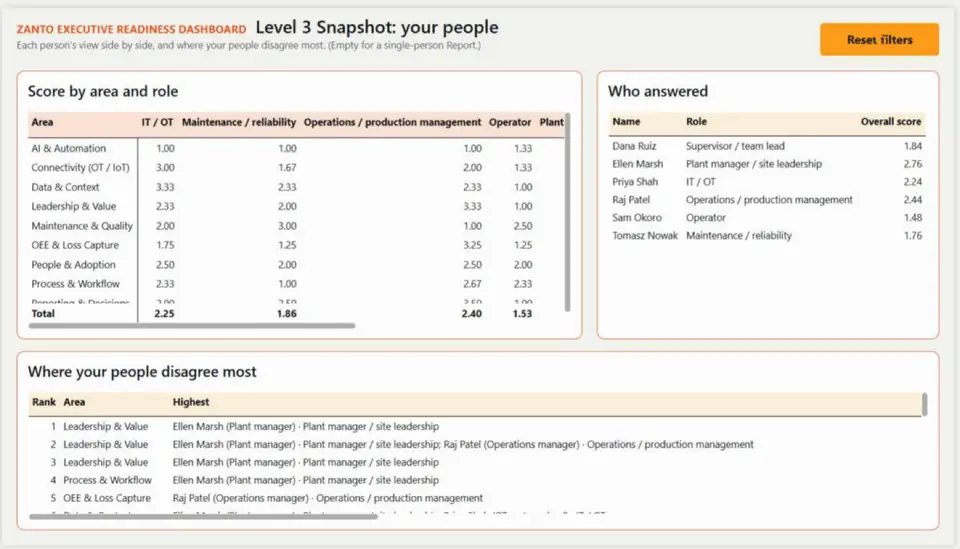
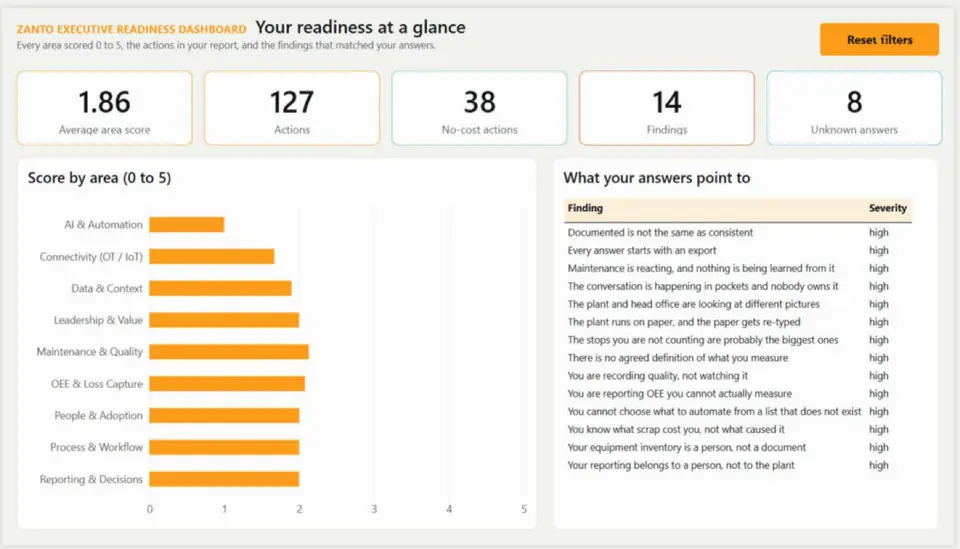
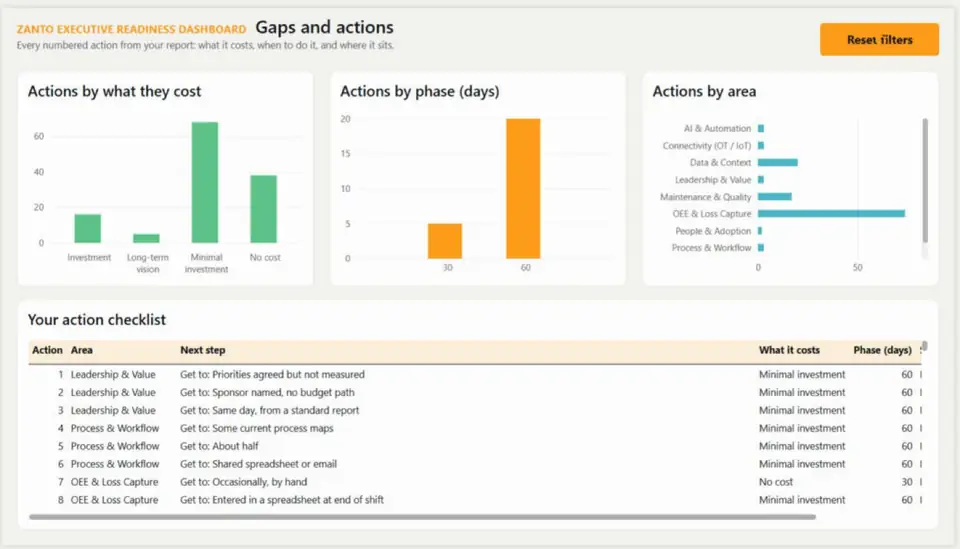
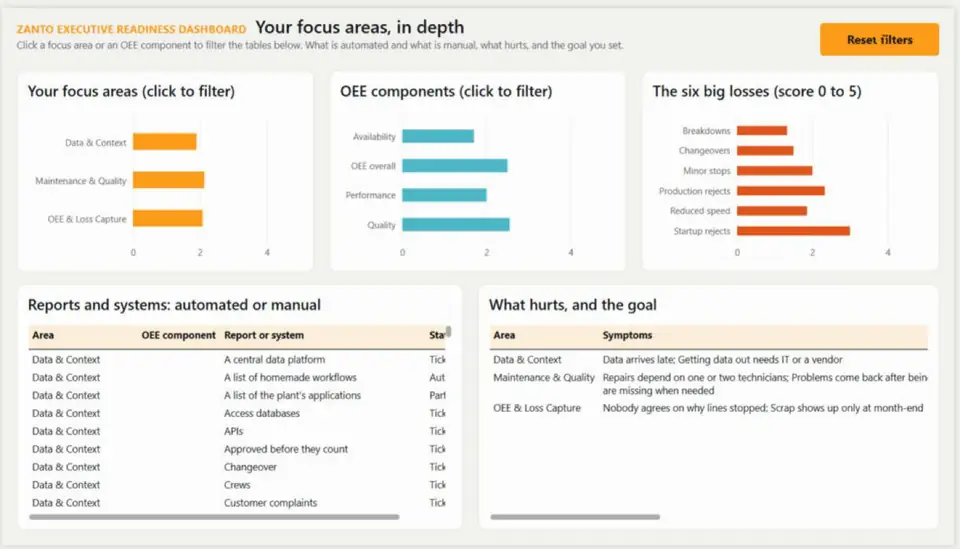
Sample data. Yours shows your own numbers. Click to enlarge; tap the X to close.
The nine sections, in orderAfter a contents page, a “Find your area” table, an “If you lead…” guide and a one-page executive summary
- Section 1 · Your group’s Readiness Report — every section of the Readiness Report: where you stand area by area, the shape of your answers, what the pattern means, the findings, what it takes to reach the next level, the ten moves that lift the score fastest, a 90-day sequence and every area in full. Built on your group’s middle answer to each question, not one person’s view.
- Section 2 · Your three focus areas, in depth — the three areas you choose at the kickoff, each answered in depth by the person who owns it.
- Section 3 · Who sees what — who answered and who didn’t; how far apart your people are in every area; where the roles disagree and which pairs of people differ most; who points at whom; office and floor; the common ground; the ten agreed moves; and every question with every person’s answer, including the deeper Level 2 questions.
- Section 4 · One page per person — each person against the group, then their full answer sheet beside the group’s middle answers.
- Section 5 · The readout agenda — the optional 60-minute readout, pre-filled from your answers, so the call goes straight to what matters. If you skip the call, it reads as a guide for your own team meeting.
- Section 6 · Action checklist — every action in the report, numbered once, with a suggested owner. The same list comes as a spreadsheet tracker.
- Section 7 · Your readiness at a glance — the executive dashboard: your group’s position, the range of views and the disagreement map.
- Section 8 · Limits, the scale and re-scoring — what several self-reports still cannot tell you, what each level from 0 to 5 means, and how to re-score in 90 days.
- Section 9 · Where this goes next — the five levels, where you are on them, and the next step if you want to go further.
What only a group can showThe range, the disagreements and the common ground
- The range, not an average — your result reads “between X and Y, depending on who you ask.” Averaging would hide the very thing you need to see.
- Where your people disagree — the questions where roles answer furthest apart, side by side. Each one is a question to ask in the readout, not a verdict.
- Who points at whom — when one role scores another role’s area low and that role scores itself high, the report says so.
- Common ground — what everyone agrees on: the strengths you can build on and the gaps nobody will argue about.
- A level deeper — Level 2 questions in every area go beneath the 25 core questions, answered by everyone. They are only in the Snapshot; the Report goes deeper on three areas you choose.
- Ten moves, weighted by agreement — the moves most of your people already back come first, so the plan starts where it will get traction.
One worked exampleA single disagreement, as the executive summary shows it
From a sample Snapshot built on a fictional manufacturing plant and six synthetic respondents. The executive summary opens with the range:
Then the three biggest disagreements, each with who said what. The first:
The same question, two people, opposite ends of the scale. That gap is what the readout is for.
How it runs, start to finishAbout two weeks from kickoff to readout
- Kickoff by video conference call, 30 minutes — we agree on the facility, the departments and functions in play, who answers (3 to 10 roles from a fixed list) and your three focus areas.
- Everyone answers separately — you forward one link. Each person spends about 30 minutes; the owner of each focus area answers its in-depth questions too. The link stays open for 14 days.
- Named by default — each person gives their name and job title, so you can compare who said what. Choose role-only at the kickoff if your culture needs it; everyone is told which before the first question.
- The report — prepared, reviewed by a person and sent as a PDF with your data files and the action tracker.
- Optional readout by video conference call, 60 minutes — if you want it, we walk your team through the disagreements, the common ground and the ten agreed moves, and agree on who owns each.
Manufacturing or healthcare operations — one facility, 3 to 10 people plus a sponsor, all online. More than one facility or more than 10 people is a custom Private Consultation.
Named by default, role-only if you prefer
A Snapshot is not an anonymous survey. By default each person gives their name and job title, and the report shows who said what next to their role, so you can compare, say, a maintenance manager with a technician in the same function. If your culture needs it, you can choose role-only at the kickoff, and answers are then reported by role, never by name.
Either way, every respondent is told before the first question exactly how their answers will be shown. We never collect respondents' email addresses, and the healthcare questions ask nothing about patients.
When the Snapshot fits, and when something else does
Before you buy
How long does it take? About two weeks from kickoff to readout. Each respondent spends about 30 minutes; your sponsor joins the two calls.
Who answers the deeper questions on the three focus areas? The person who owns each area, agreed at the kickoff (one person can own two). They get their own private link and spend 10 to 25 minutes more, depending on the area; everyone else answers only the main questions.
How many people? At least 3 and up to 10, plus one sponsor. Fewer than three roles and the report says so on its first page.
How long is the report? Usually over 100 pages, because it holds the full Readiness Report plus every person’s view. Page 2 lists every part and its page, and an “If you lead…” guide sends each leader to their own areas.
What if someone doesn't answer? Roles that were expected but never answered are named in the report, so a gap is visible rather than hidden.
Is anything written about us by hand? No. Every score, rung and move comes from one documented method and your own people's answers.
When can we take it? From launch. After you buy, we book a 30-minute kickoff with you and set up your team's link the same day.
See your operation through your people's eyes
Several roles, deeper questions, the range of views and the ten moves your people already back.
Available at launch · ask us → Or start with the $1,199 Report